Fees and LAA Billing in Custody Note
The Time Recording & Fees section brings together every time entry from across the attendance and presents it as a structured billing record. Here is how to use it to support your LAA police station claims.
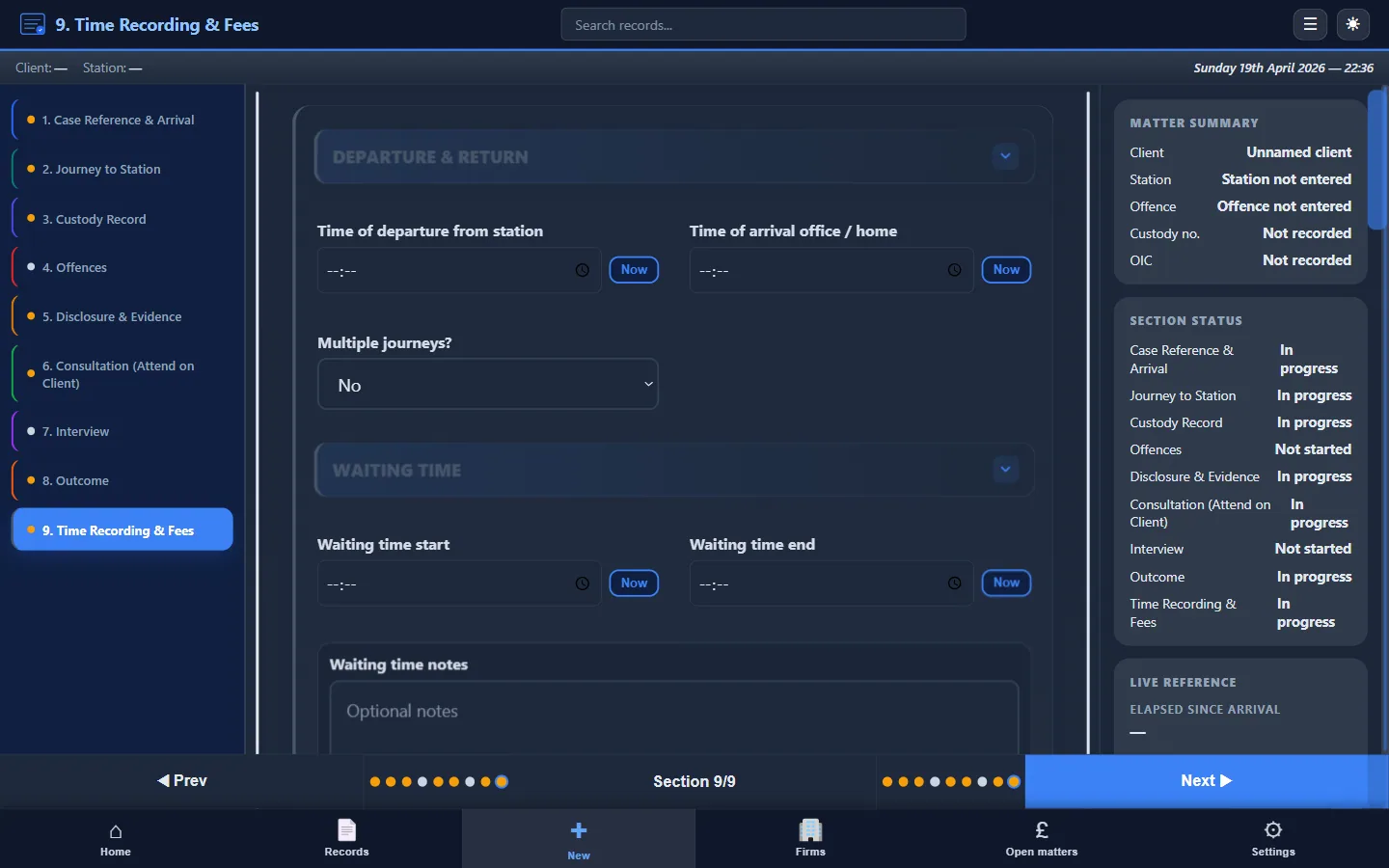
The Time Recording & Fees section of Custody Note is designed specifically around the practical requirements of claiming under the police station legal aid scheme. It draws on time entries from across the attendance and presents them in a format that supports the standard LAA billing process.

How Time Entries Work
Time entries in the Fees section correspond to the distinct phases of the attendance:
- Travel and waiting time (from instruction to arrival)
- Reading and reviewing the custody record
- Reviewing disclosure
- Client consultation
- Interview attendance
- Post-interview consultation
- Any additional attendance (for example, a bail review)
Each entry has a start time, an end time, and a description. The total time is calculated automatically. Where a previous section, such as Consultation, already captured start and end times, those times are carried through to the Fees section automatically, reducing duplication.
Telephone Advice
Where the attendance included a period of telephone advice before physical attendance, which is separately claimable under the police station scheme, telephone advice is recorded in its own dedicated form (the INVB workflow), and either claimed separately or aggregated into the matter at billing time.

The Open Matters Dashboard
Across all your matters, the Open Matters dashboard surfaces what still needs doing: matters that are missing supporting documents, matters ready to invoice, and matters where the invoice has been raised but is still outstanding. It turns "what should I work on next?" into a single number on a tile.

Exporting for Billing
The completed Time Recording & Fees section contributes to the PDF export of the full attendance note. The exported document includes a structured fees summary alongside the full attendance record. This can be used as the supporting documentation when submitting a claim, and can also be retained on file in the event of an LAA audit.
Retaining a copy of the complete exported note, including the fees section, means that if a claim is queried months or years later, you have a contemporaneous record of exactly what time was spent and why.
Note: This article is intended as general information for criminal defence practitioners in England and Wales. It doesn't constitute legal advice. Solicitors and accredited representatives should exercise their own professional judgment in each case. Law and practice may change; always verify current requirements with primary sources.