Attendance Notes for Legal Aid Billing: How Your Notes Support Your Claim
Your attendance note and your LAA billing claim describe the same work. If they don't match, the claim is vulnerable. This guide shows exactly how each section of your attendance note feeds into your legal aid billing.
For the full guide to attendance notes, see Police Station Attendance Notes (UK Guide). For the broader LAA context, see LAA Attendance Notes Explained.
The connection between notes and claims
Every LAA billing submission, whether fixed fee or escape fee, requires a file that supports the claimed work. The attendance note is the primary evidence. An assessor reviewing your claim will check:
- Does the note describe the work claimed?
- Do the times match the fee narrative?
- Is the attendance type consistent with the fee code?
- Are disbursements supported by the record?
If the attendance note is weak, the claim is weak, regardless of the work actually done.
Fixed fee claims
The standard police station fixed fee is £320 (INVC, as of December 2025). For fixed fee claims, the attendance note must demonstrate that the work was done and the correct fee code applies.
The attendance note supports the fixed fee claim by confirming:
- The type of attendance (custody, voluntary, telephone)
- That the practitioner attended (or advised by phone)
- The nature of the work (disclosure, consultation, interview)
- The outcome
For most fixed fee claims, a well-structured attendance note is sufficient. Problems arise when the note is so vague that the assessor can't confirm even the basics.
Escape fee claims
This is where your attendance note becomes critical. Where profit costs at Schedule 4 hourly rates exceed the £650 escape threshold (excluding VAT, from 22 December 2025), the claim is the £320 fixed fee plus the hourly excess over £650 — not hourly rates instead of the fixed fee. Your note must show the time that supports that calculation.
The time breakdown in your attendance note is the primary evidence. You need:
- Travel time: with departure and arrival timestamps
- Waiting time: between arrival and the start of work
- Consultation time: with start and end times
- Interview time: with start and end times
- Post-interview time: wrap-up, second consultation, admin
A single “total: 4 hours” doesn't support an escape fee claim. The assessor needs to see each component separately.
Your attendance note should also include a brief complexity narrative: why the matter required more time than a standard attendance. For example: multiple suspects requiring separate consultations, complex fraud allegations requiring extended disclosure review, interpreter involvement extending each stage, or overnight detention with multiple reviews.
Travel claims
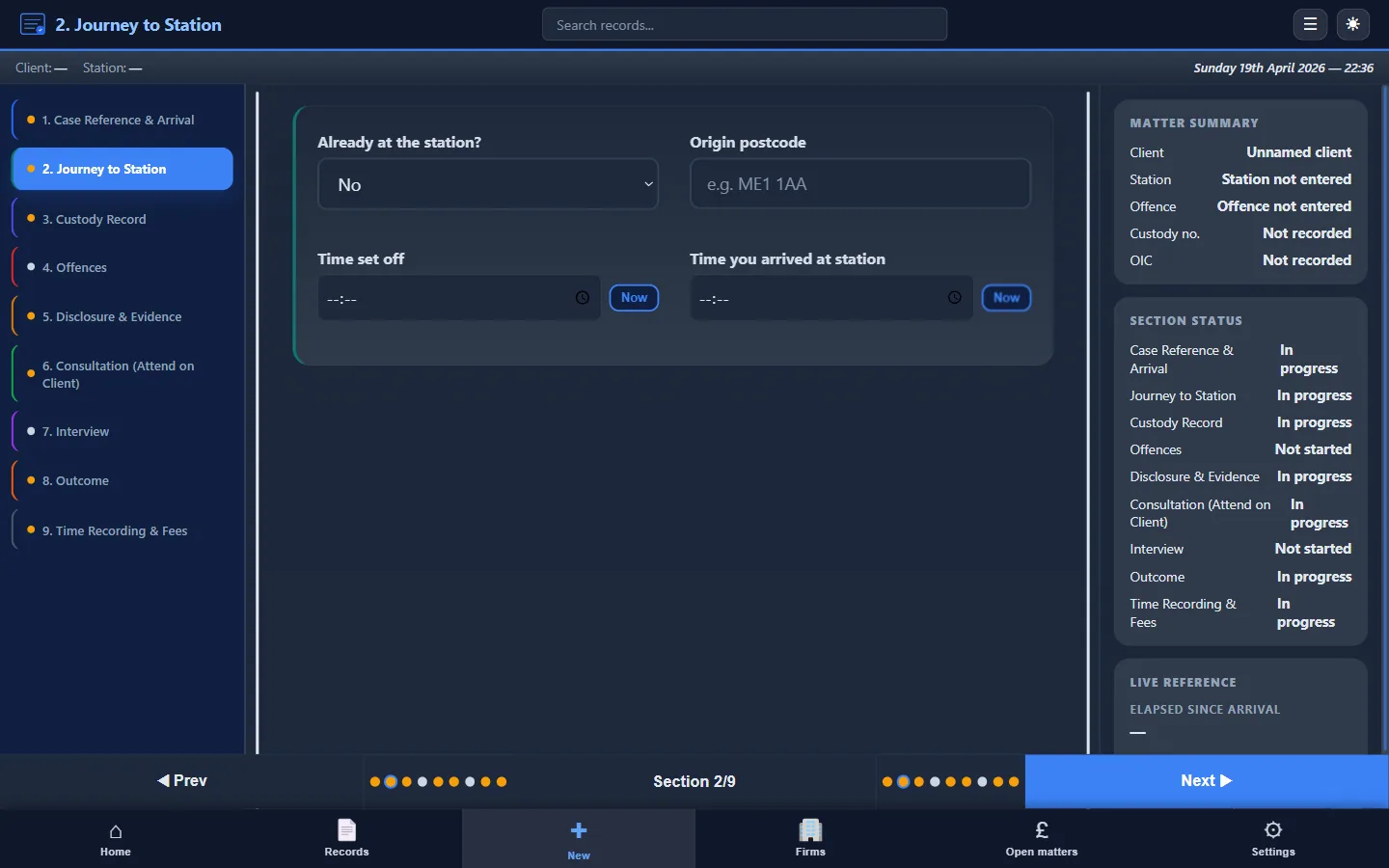
Travel time is claimable where the Standard Crime Contract allows. Your note must record:
- Time you departed
- Time you arrived at the station
- Distance or route (where relevant for mileage claims)
If you attended multiple stations in one shift, the note for each attendance should show the journey context.
Waiting time
Waiting at the station between arrival and the start of work is a common component of police station claims. Your note must record:
- Time of arrival
- Time of first consultation or first substantive work
- Reason for waiting (client not available, officer not ready, custody suite processing other matters)
Unexplained gaps between arrival and first work will be questioned.
Disbursements
Interpreter fees, mileage, and other disbursements must be linked to a dated attendance and a specific matter. Your attendance note should record:
- What the disbursement was (interpreter, mileage, etc.)
- The amount (or approximate)
- Which attendance it relates to
“Orphan” disbursements (receipts that can't be matched to an attendance) are a common audit problem.
The SaBC system
Since February 2026, claims are submitted through the LAA's Submit a Bulk Claim system. Providers submit monthly by the 20th. The system calculates fees based on the fee codes and data you provide. Structured attendance notes make SaBC submissions faster and more accurate because the data (attendance type, times, disbursements) is already captured in a consistent format.
Building billing into your attendance note workflow
The most efficient approach is to record billing data as part of the attendance note, not as a separate exercise afterward. That means:
- Record times as they happen: travel, waiting, consultation, interview
- Note the claim type: fixed fee or potential escape
- Record disbursements at the time they occur
- Export the complete record: note + billing data, in one action
From attendance to billing in one workflow.
Custody Note builds LAA billing fields, time recording, fee calculation, and QuickFile invoicing into the same record. No retyping. No reconciliation. Free during beta.
Download free