Police Station Attendance Notes: The Complete UK Guide
Your attendance note is the only contemporaneous record of what happened during a police station visit. It protects the client, supports your billing, satisfies your professional obligations, and serves as the handover document for everyone who touches the file after you leave.
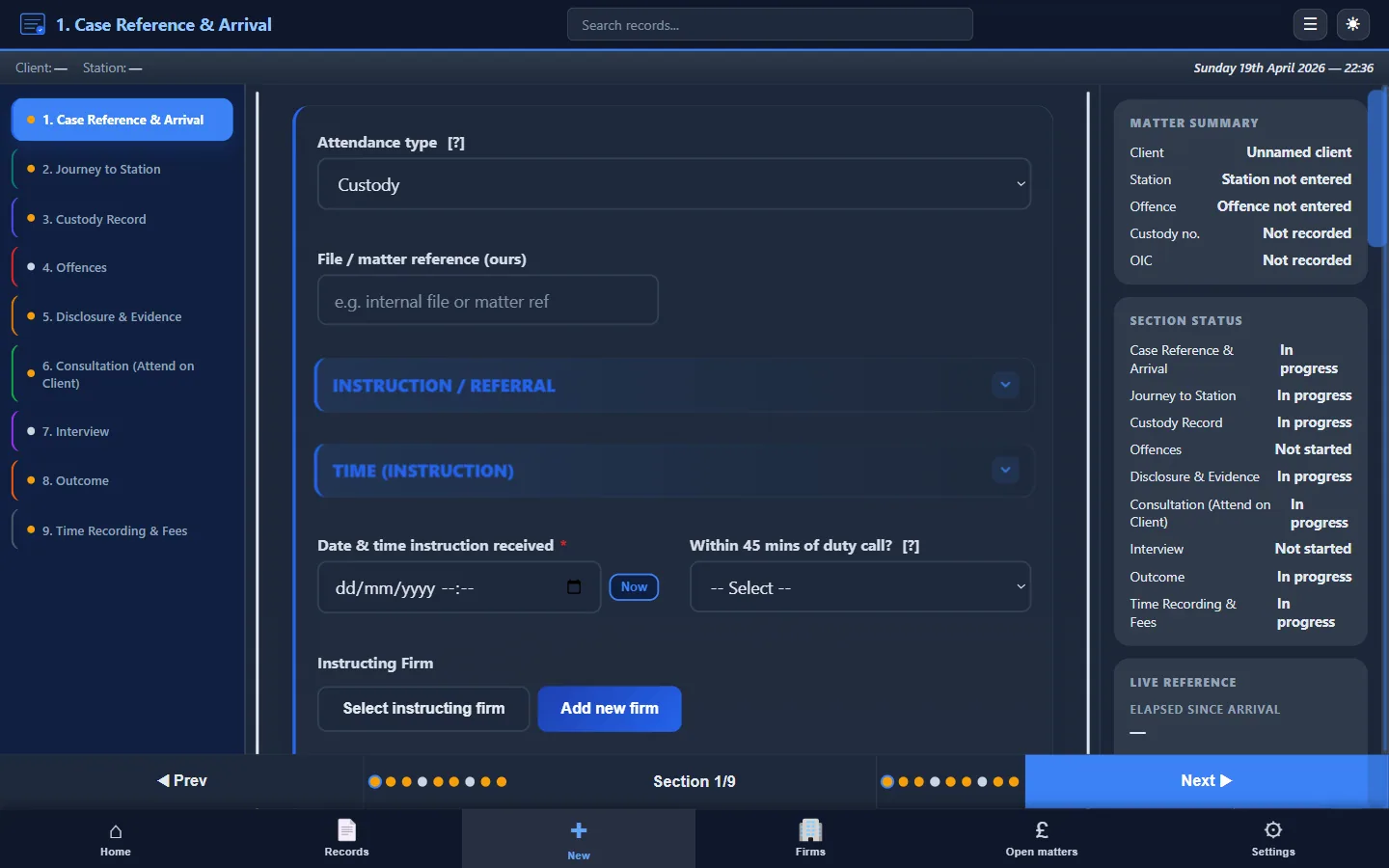
This guide covers what goes into a thorough, defensible police station attendance note, for a PACE custody interview, a voluntary attendance or telephone advice.
What are police station attendance notes?
A police station attendance note is a structured written record created by the solicitor or accredited representative who attends a police station on behalf of a suspect. It captures the key facts, the advice given, the decisions made, and the outcomes, from instruction through to departure.
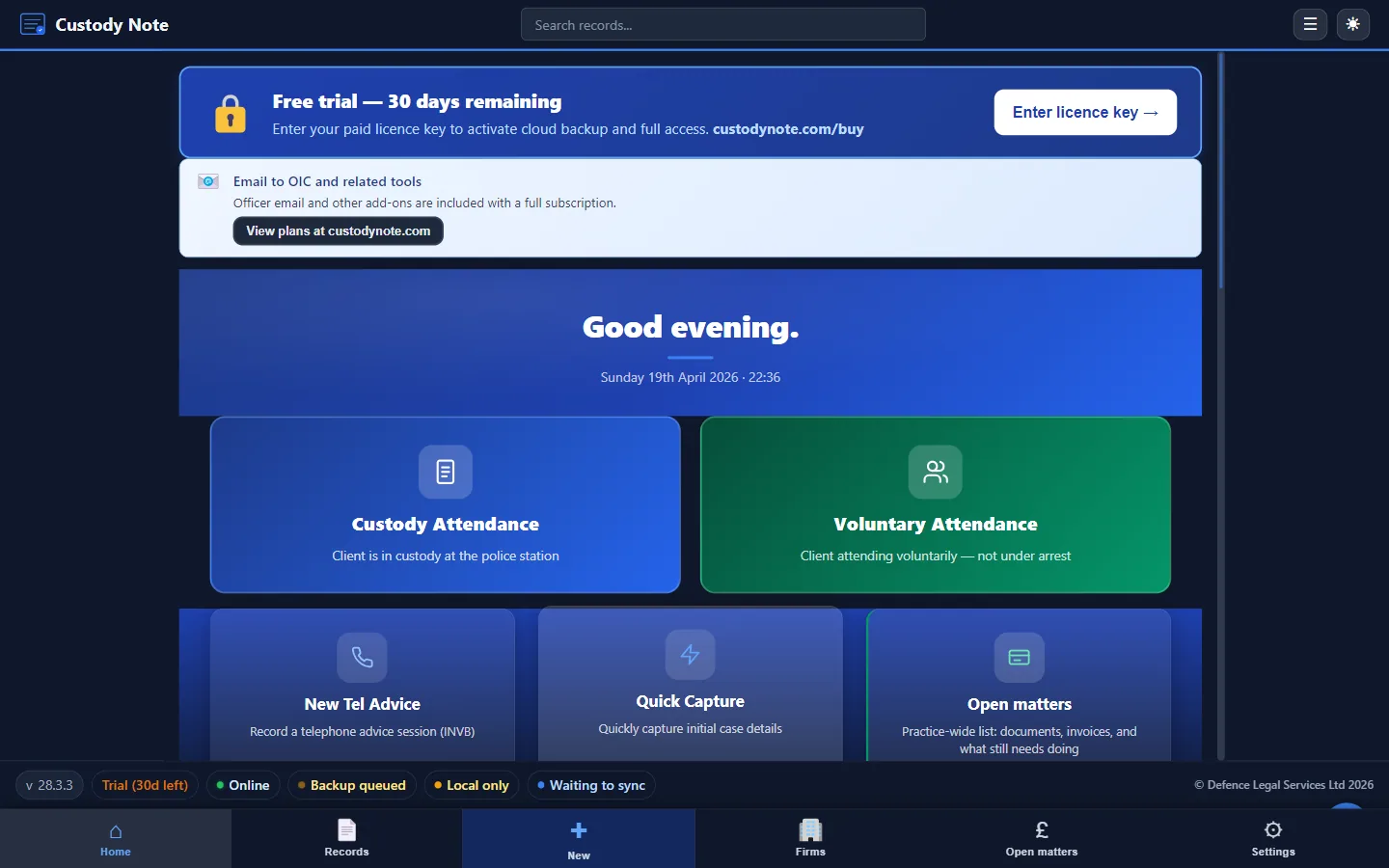
“Attendance note” is the standard term used by the Law Society, the Legal Aid Agency, and most firms. It covers three types of police station work:
- Custody attendances: the client is detained under PACE at a police station
- Voluntary attendances: the client attends by appointment for interview, not under arrest
- Telephone advice: initial advice given remotely, usually before a decision to attend in person
Each type follows the same core structure but varies in depth.
Why “attendance notes” rather than “custody notes”?
Practitioners sometimes say “custody notes” informally, but “attendance note” is the correct professional term. Your firm file, LAA claim narrative, and any court disclosure will refer to “attendance notes.” Using consistent terminology avoids confusion and strengthens the record.
Why police station attendance notes matter
Client defence
Your note may be the only evidence of what advice was given, when it was given, and what the client instructed. If the matter goes to trial, the note supports:
- Prepared statement context: proving the statement was based on considered legal advice
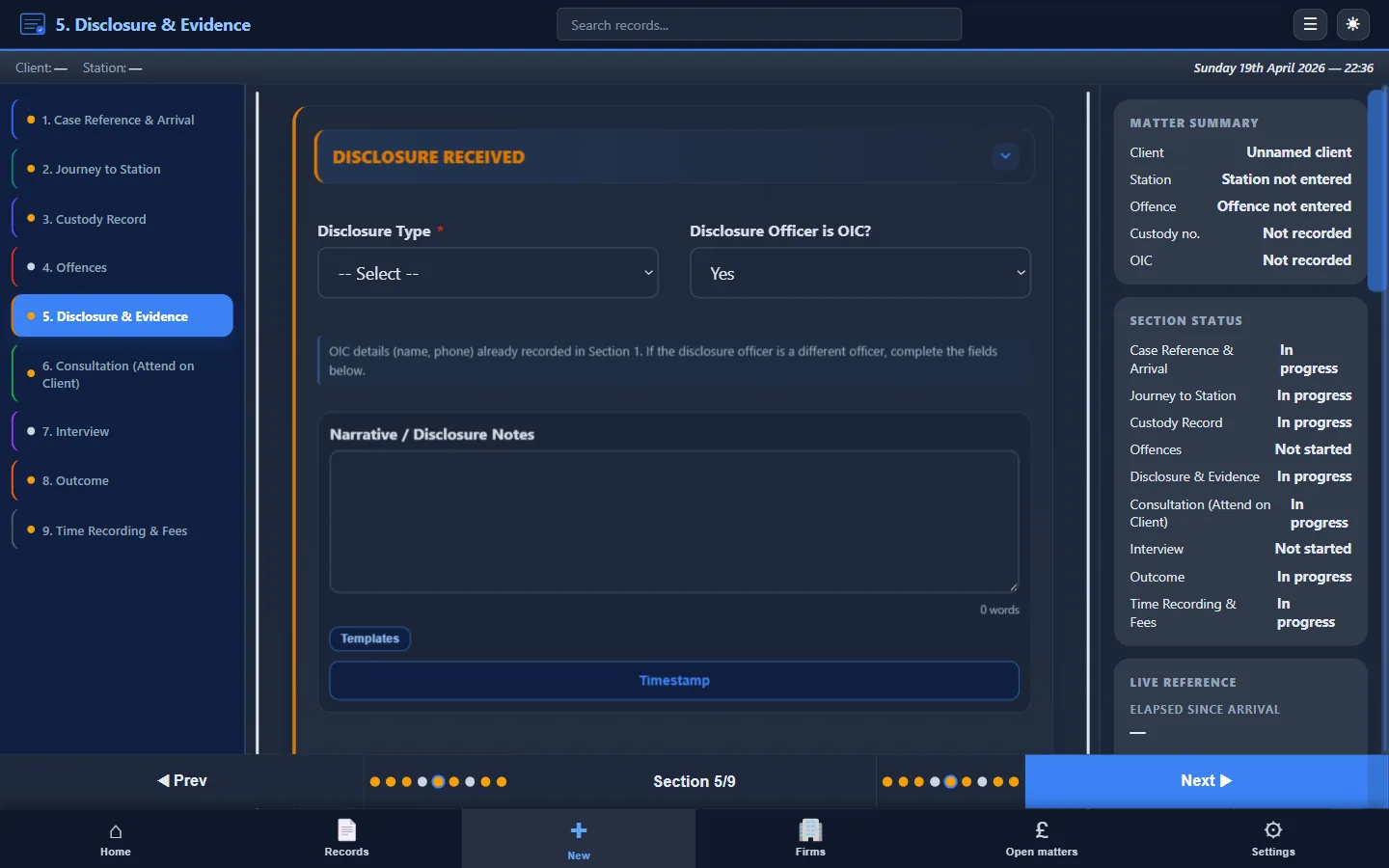
- Disclosure challenges: documenting what was and was not disclosed before interview
- Abuse of process arguments: recording PACE breaches, denied rights, or improper conduct
- Ambush defence disputes: showing the factual basis for the client's position existed before trial
Without a thorough attendance note, you rely on memory. Memory isn't evidence.
LAA billing and audit
The Legal Aid Agency requires your file to support the claim. Your note must show what work was done, when, how long each stage took, and the nature and complexity of the matter.
The standard fixed fee for police station attendance is £320 (as of December 2025). Escape fee claims apply where profit costs at Schedule 4 hourly rates exceed the £650 escape threshold (excluding VAT) for UFNs from 22 December 2025; the claim is the £320 fixed fee plus the hourly excess over £650, not hourly rates instead of the fixed fee. A detailed time breakdown is primary evidence. (Before harmonisation, thresholds used scheme-specific multiples such as three times the fixed fee — that rule is historic.) Since February 2026, claims are submitted through the Submit a Bulk Claim (SaBC) system.
A structured attendance note written at the time of the attendance is your first line of defence against LAA auditors. For the full guide, see LAA Attendance Notes Explained.
Professional accountability
The SRA expects solicitors to maintain proper records. For accredited representatives, the supervising firm needs to review what happened without relying on a phone call. A structured attendance note satisfies both requirements.
File handover
Police station work is often handled by one practitioner, then the file moves to another for court proceedings. Your attendance note is the handover document. If it's incomplete, the next fee earner starts at a disadvantage, and so does the client.
What every police station attendance note must include
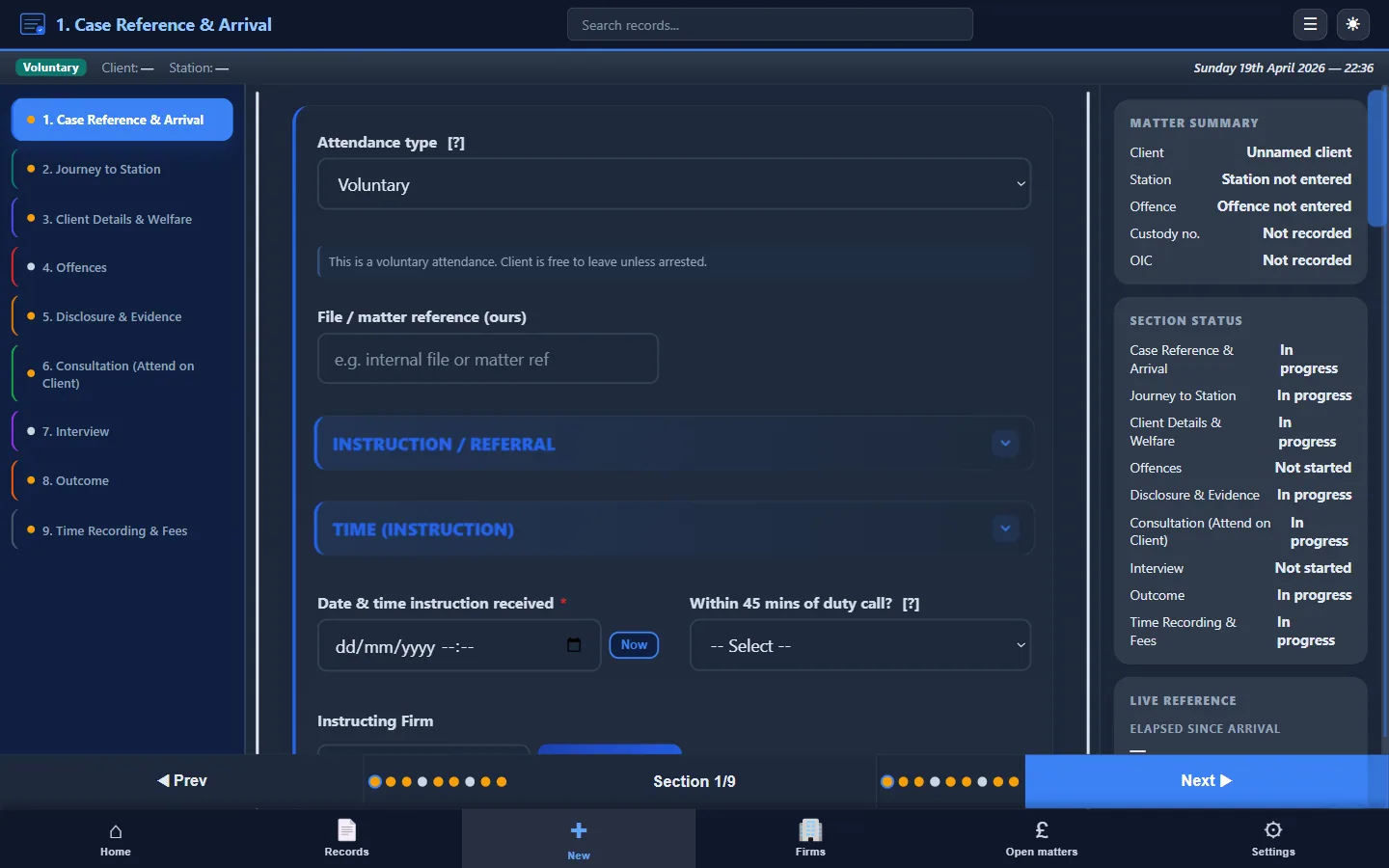
A comprehensive guide to required sections is in our dedicated page: What Must Be Included in Attendance Notes. The essential sections are:
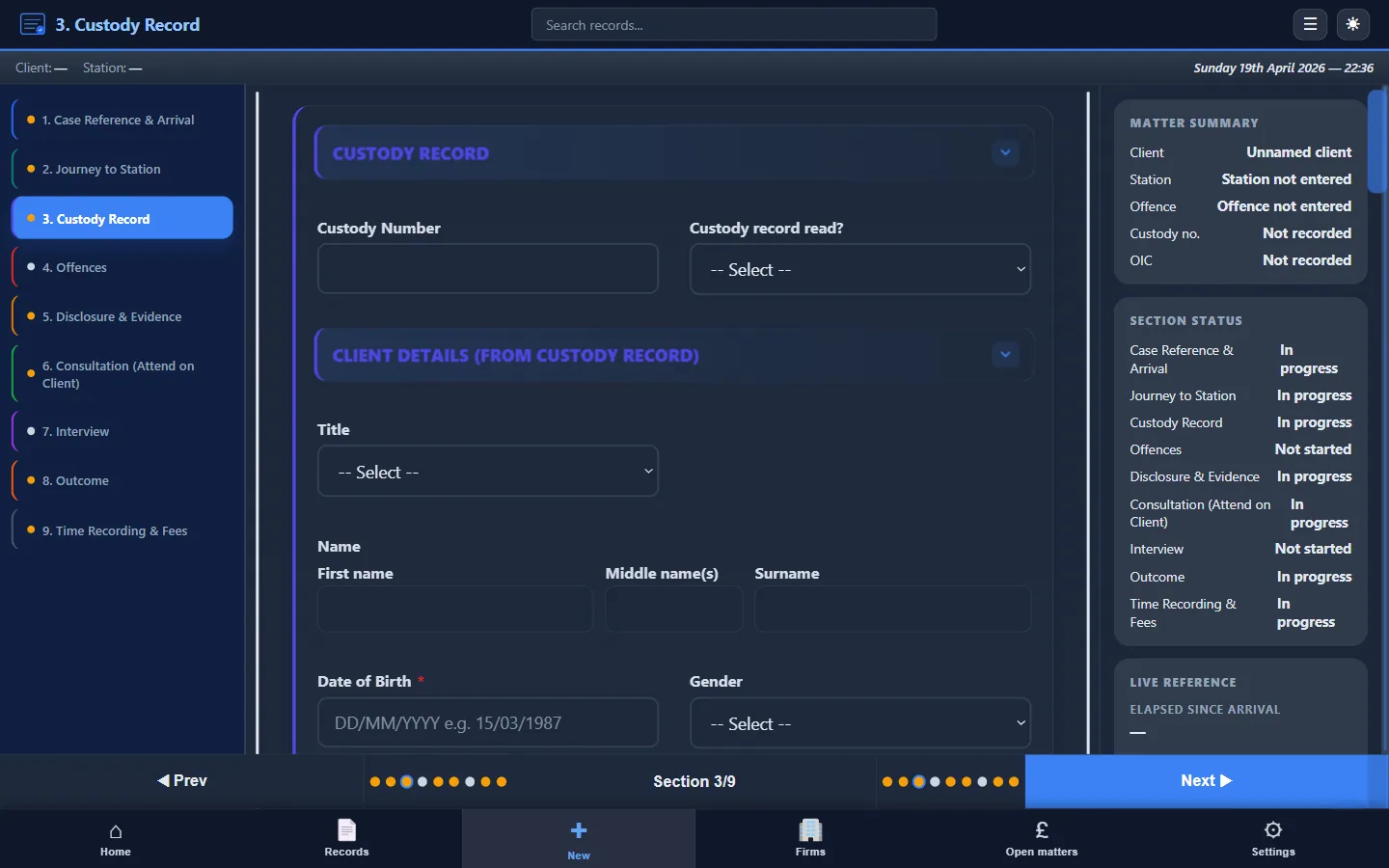
- Case identifiers: client name, DOB, custody record number, DSCC reference, station, offence, date
- Notification and arrival: time of instruction, arrival at station, booking in with custody officer
- Disclosure: what was disclosed, what was withheld, your assessment of sufficiency
- Consultation: advice given, instructions received, agreed interview strategy, vulnerabilities
- Interview: start/end times, summary of questions and responses, objections, representations
- Outcome: NFA, charge, bail, RUI; conditions; next steps
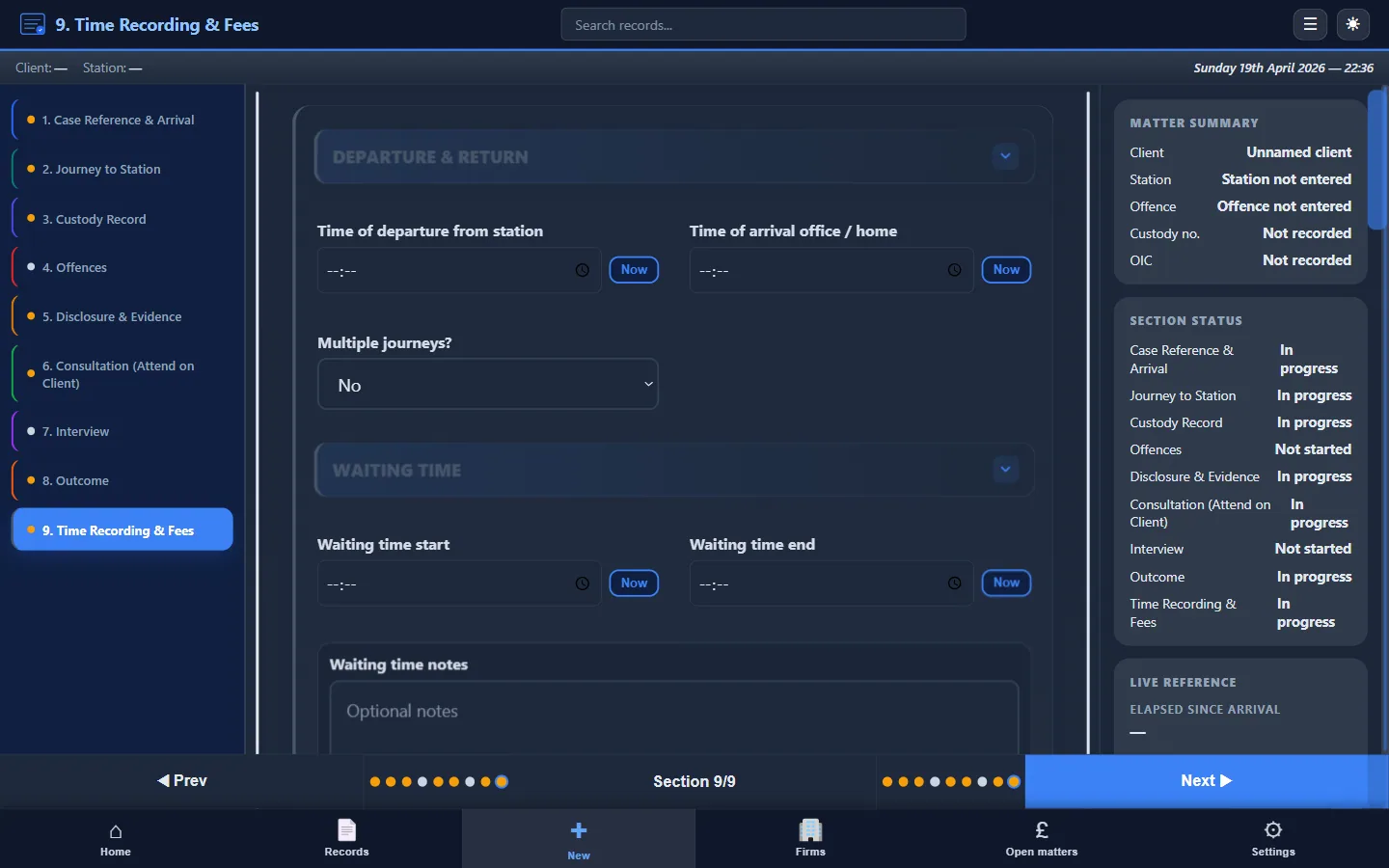
- Time summary: broken down by travel, waiting, consultation, interview, post-interview
Attendance notes by type
PACE custody attendance
The most detailed note. Covers all sections above plus detention review times, representations, s.56 and s.58 rights, appropriate adult involvement, and any extensions of detention.
Voluntary interview
The client isn't detained, so custody-specific elements don't apply. However, all other sections remain relevant. Record that the client attended voluntarily, whether they were cautioned, and whether they were informed of the right to legal advice.
Telephone advice
The shortest form. Record the date, time, who called whom, the allegation, the advice given, whether attendance in person was recommended, and the outcome.
Structure and consistency
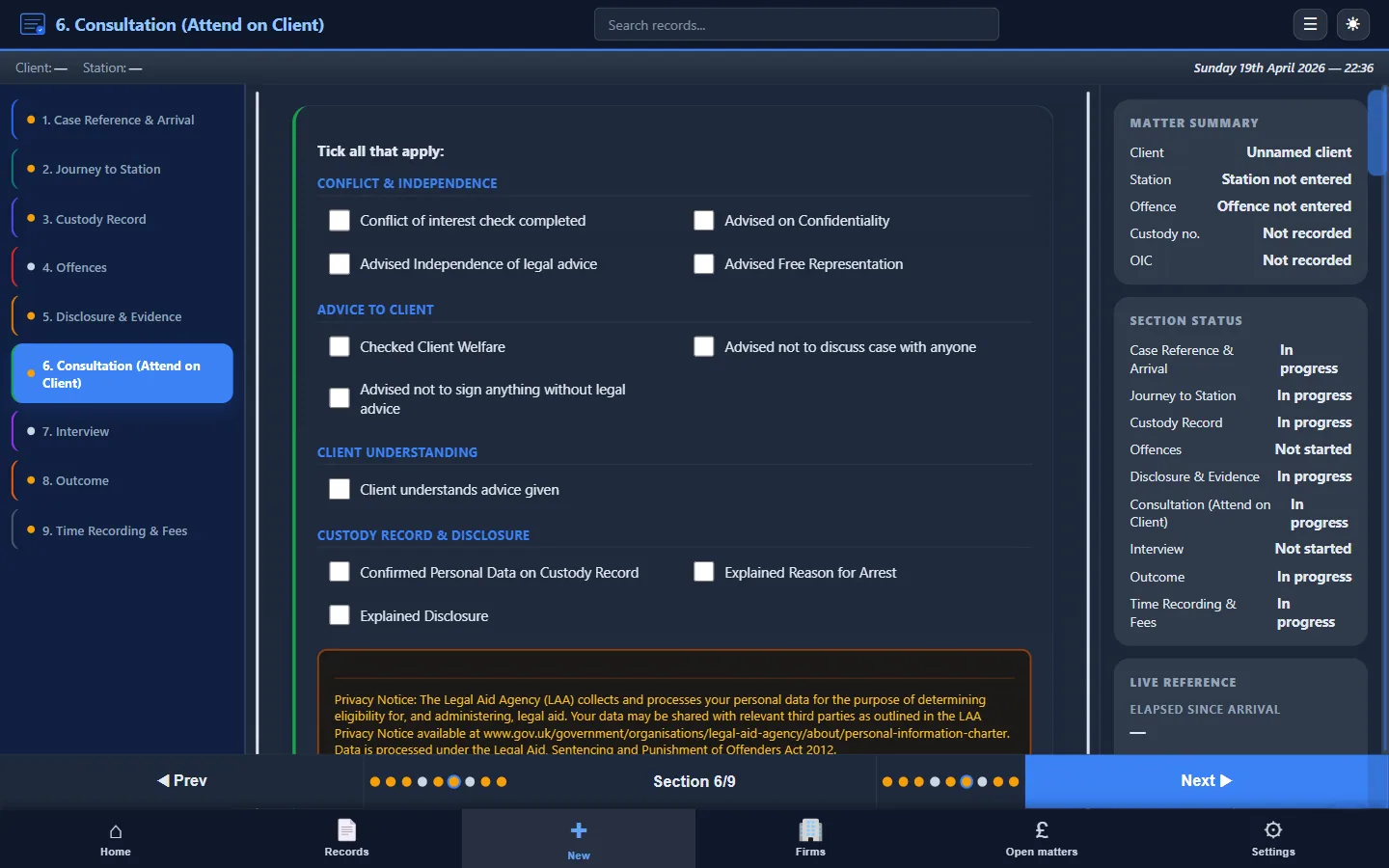
Use the same section order for every attendance. Supervisors, billing teams, and future fee earners should know exactly where to find each piece of information. The alternative (free-text narratives with inconsistent headings) creates gaps, slows handover, and causes problems at audit.
For a step-by-step guide to the writing process itself, see How to Write Attendance Notes.
Common mistakes
The errors that cause the most problems at audit, in court, or on file review are predictable and avoidable:
- Writing “advised client” without recording the substance of the advice
- Writing “disclosure given” without recording the content
- No time breakdown: a single total rather than travel, waiting, consultation, interview
- Missing DSCC reference or custody record number
- Writing up from memory hours later instead of contemporaneously
- Multiple inconsistent versions
- No outcome or next steps recorded
For a detailed analysis of each mistake, see Common Mistakes in Attendance Notes.
PACE requirements
PACE Code C doesn't prescribe a format for solicitors' notes, but it creates the factual framework your note must capture. Key provisions include Code C 3 (custody officer duties), section 6 / Note 6J (consult privately with a solicitor), 6.8 (solicitor present at interview), 11.1A (pre-interview disclosure), 12.8 (interview breaks), and 15 (detention reviews). See our PACE attendance note requirements guide.

Tools for writing attendance notes
Paper: Still used by some practitioners but declining. Handwritten notes are hard to read, easy to lose, and slow to type up.
Word templates: An improvement on paper. A good template prompts the right sections. The downsides: templates drift across teams, version control is poor, and transferring data to billing is manual. For a free template, see Attendance Note Template (UK).
Practice management systems: Systems like Lawsyst or Osprey include police station modules. Powerful for billing but usually cloud-dependent, which is a problem at stations with unreliable Wi-Fi.
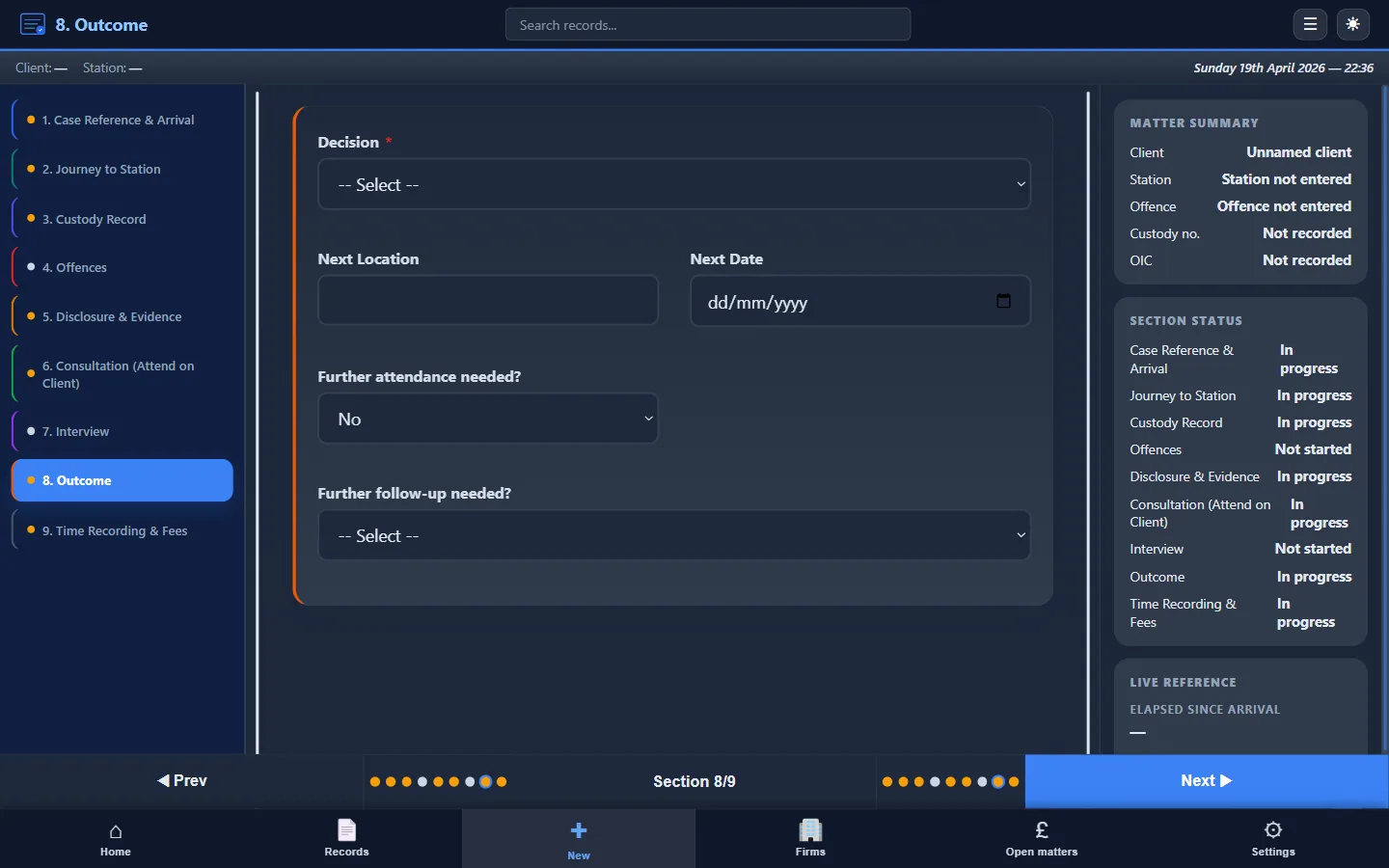
Dedicated software: Custody Note is a Windows desktop application built specifically for police station attendance notes. It provides section-by-section structure for custody, voluntary, and telephone attendances, with offline support, AES-256 encryption, instant PDF export, and billing fields set out for LAA claims. Free during beta, no card needed.
For an honest comparison of all approaches, see Digital vs Paper Attendance Notes.
See it in practice
- Police Station Notes Example: full annotated worked examples
- Attendance Note Template (UK): free downloadable template
- What Must Be Included in Attendance Notes: a section-by-section checklist
- Police Station Interview Notes: best practice for the interview section
Summary
A good police station attendance note is structured, contemporaneous, complete, and internally consistent. It protects the client, supports your billing, satisfies your professional obligations, and survives scrutiny from a court, an LAA assessor, or a conduct review.
Start with a consistent structure. Record each section as the attendance progresses. Export or file the note before you leave the station.
Want this structure built into guided forms?
Custody Note walks you through each section at the station: offline, encrypted, with instant PDF export. Free during beta, no credit card.
Download free