Police Station Attendance Note Example: Full Annotated Breakdown
Seeing a finished, well-structured attendance note is more useful than any amount of theory. This page provides three full worked examples — one for each attendance type — annotated so you understand what each section should contain and why.
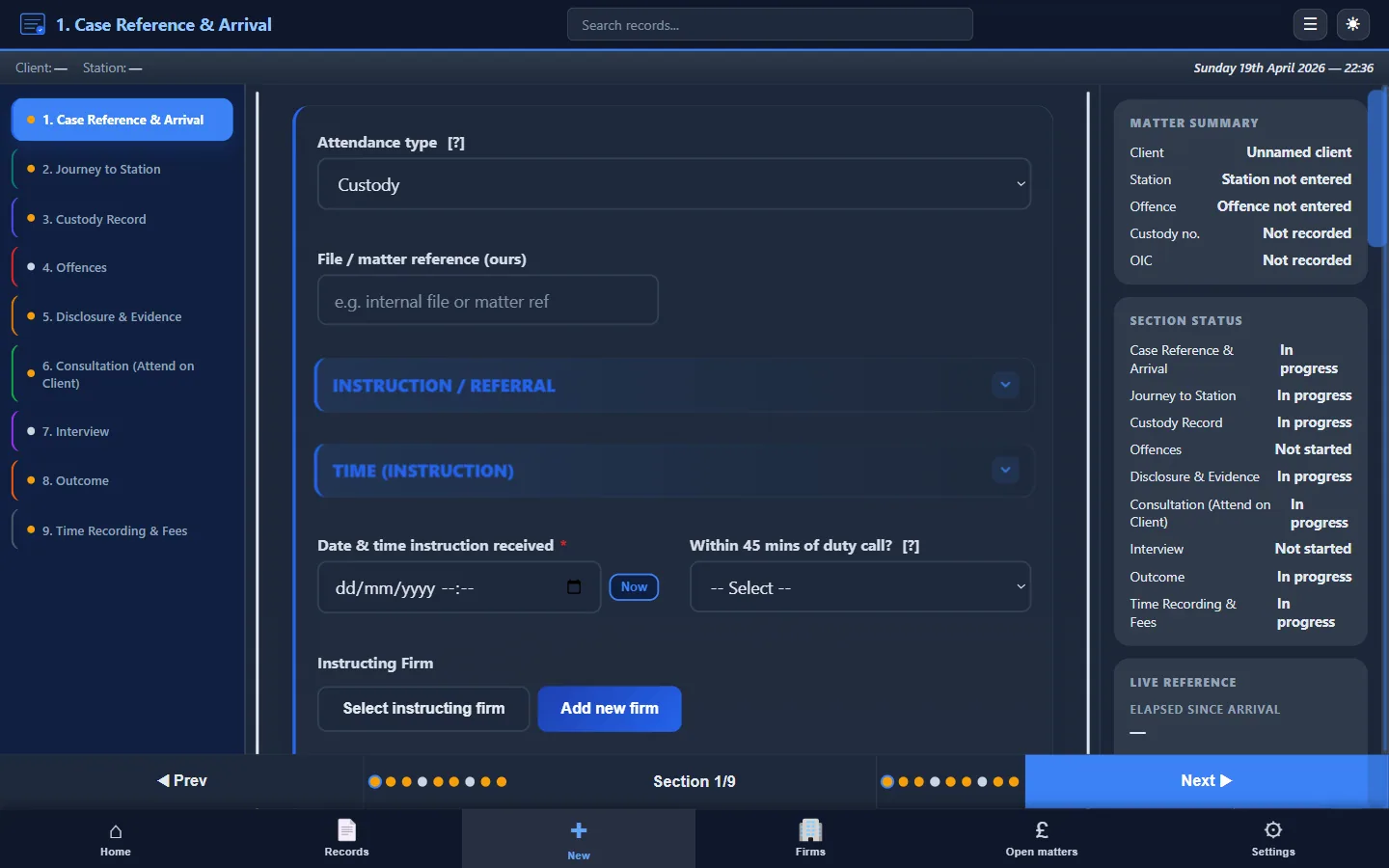
All examples are fully anonymised. For the complete guide to writing attendance notes, see Police Station Attendance Notes (UK Guide).
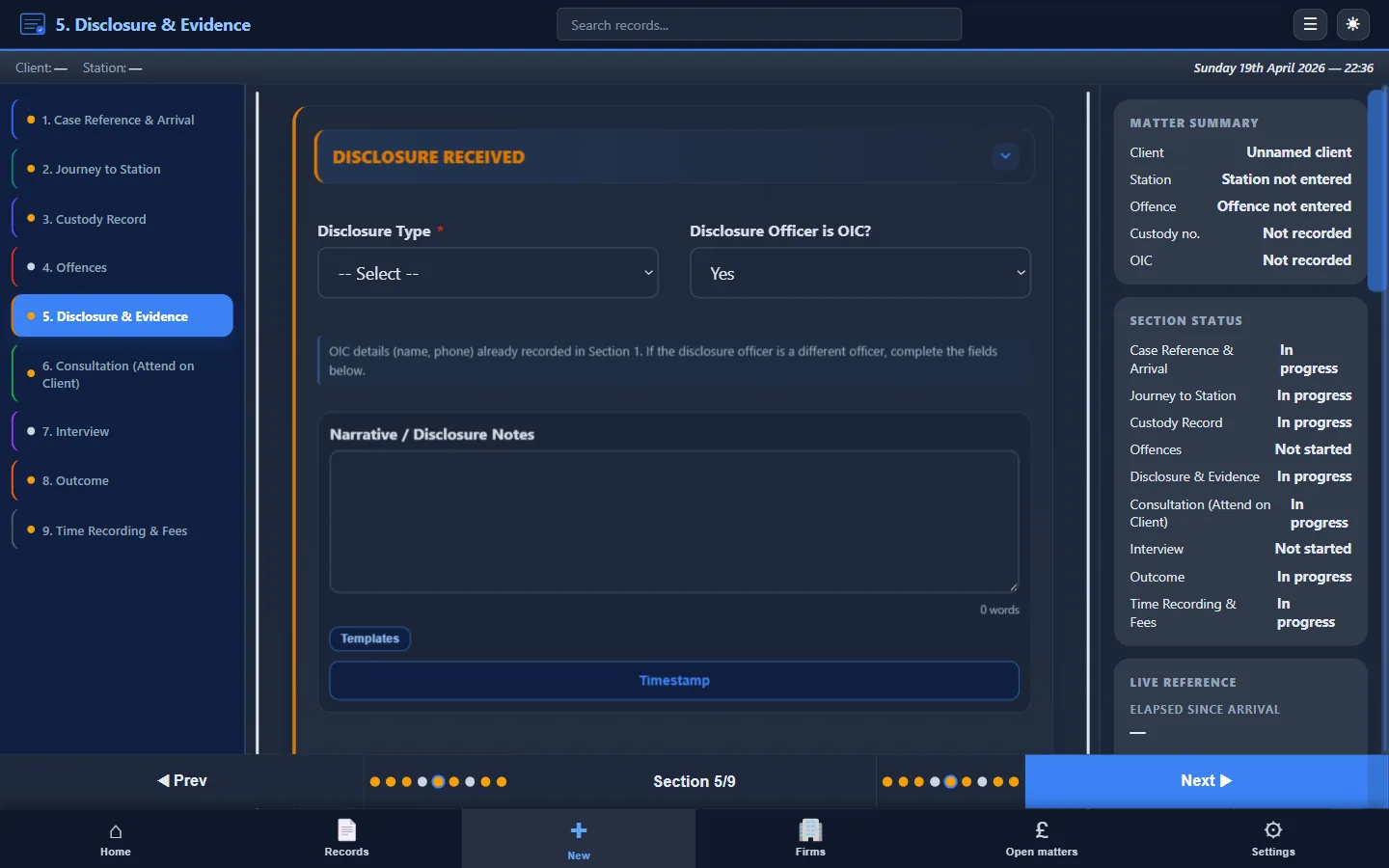
Example 1 — PACE custody attendance
Header / case identifiers
DSCC Ref: 1234567
Custody Record: AB/12345/26
Station: Anytown Police Station
Client: J. Smith (DOB: 01/01/1990)
Offence: Theft — Theft Act 1968, s.1
Date: 15 March 2026
Solicitor: A. Practitioner (Defence Legal Services Ltd)
Why: Every field serves a specific purpose. The DSCC reference links to your LAA claim. The custody record number links to the custody officer's log. Missing any one creates administrative problems downstream.
Notification and arrival
Call received: 02:15
Arrived at station: 02:50
Booked in with custody officer: 02:55
Why: The gap between the call and arrival is travel time. The gap between arrival and consultation is waiting time. Both may be billable and both establish the factual timeline.
Disclosure
Disclosure from: DC Jones
Allegation: client suspected of theft from retail premises on 14/03/26
Evidence disclosed: CCTV showing person matching description at premises at 21:30; items recovered nearby
Withheld: identification procedure details; further witness statements
Assessment: disclosure sufficient to advise on basic allegation, limited on identification evidence
Why: This records the substance, not just that disclosure happened. If the prosecution later relies on the withheld identification evidence, this note proves it was not available to you at the time. Compare this with the common mistake of writing “disclosure given” — which tells a court or assessor nothing. See Common Mistakes in Attendance Notes.
Consultation
Consultation start: 03:05
Consultation end: 03:25
Advice: explained allegation and disclosed evidence. Discussed options — no comment, prepared statement, full account. Advised that CCTV placed client at scene but did not identify them as offender; identification evidence withheld. Client instructed that they were at premises to make a legitimate purchase.
Client decision: prepared statement addressing presence, denying theft
Strategy: prepared statement to be read at start of interview; no further comment thereafter
Vulnerabilities: none identified; client alert, oriented, no apparent impairment
Why: Records the reasoning behind the strategy, not just the decision. If the advice is questioned later, this entry demonstrates considered, competent advice.
Interview
Interview start: 03:40
Interviewing officers: DC Jones, DC Williams
Recording: audio
Prepared statement read. No further comment.
Representations: objected to leading question at 03:52 regarding client's “previous involvement in similar offences” — no disclosure of previous convictions; officer withdrew the question. Noted on tape.
Interview end: 04:10
Why: Not a transcript — a proportionate record. Representations and objections should always be noted. For detailed guidance on interview note-taking, see Police Station Interview Notes Best Practice.
Outcome and next steps
Outcome: released under investigation pending further enquiries
Bail conditions: none
Post-interview advice: explained RUI to client; no obligation to return to station unless arrested; advised to contact firm if contacted by police; diarised disclosure update request in 28 days
Departure: 04:25
Time summary
Travel: 35 min
Waiting: 15 min
Consultation: 20 min
Interview: 30 min
Post-interview / admin: 15 min
Total attendance: 1h 55m
Why: The segmented breakdown is essential for LAA billing. See Attendance Notes for Legal Aid Billing for how this feeds into your claim.
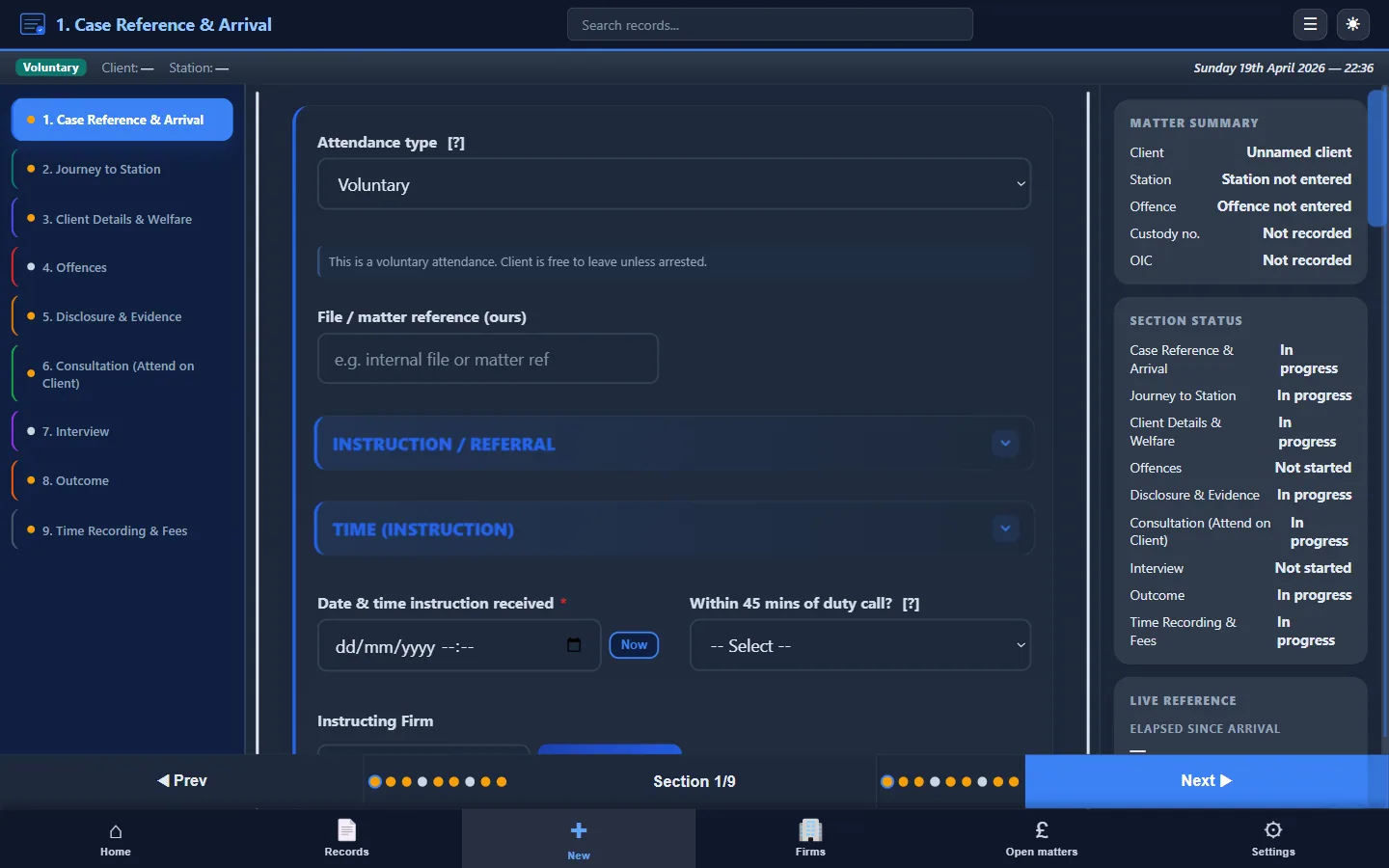
Example 2 — Voluntary interview
Header
Police Ref: CD/67890/26
Station: Riverside Police Station (Interview Suite)
Client: M. Khan (DOB: 15/06/1985)
Offence: Common assault — Criminal Justice Act 1988, s.39
Date: 22 March 2026
Solicitor: B. Representative (instructed by Smith & Jones Solicitors)
Attendance type: Voluntary — client not under arrest
Arrival
Instruction received: 09:30 (from instructing firm)
Arrived at station: 10:15
Client arrived: 10:20
Confirmed with front desk: client attending voluntarily, free to leave at any time
Disclosure
Disclosure from: PC Ahmed
Allegation: common assault on partner at home address on 20/03/26
Evidence disclosed: complainant statement alleging client pushed them during argument causing bruising to right arm; one photo of bruising
Not disclosed: body-worn video (stated to be under review); 999 call recording
Assessment: basic disclosure provided; BWV absence noted and may be significant
Consultation
Consultation: 10:25–10:50
Advice: explained allegation and available evidence. Discussed that BWV may support or undermine complainant's account. Advised on options.
Client account: argument occurred but denied physical contact; states they left the room before any physical altercation. Concerned about impact on family proceedings.
Decision: full account — client wishes to put their version on record
Vulnerabilities: none identified; client stressed but fit to be interviewed
Interview
Interview: 11:00–11:35
Officers: PC Ahmed, PC Brown
Recording: audio/video
Client gave full account as discussed. Denied pushing complainant. Stated they left the room when argument escalated. Offered to provide phone location data showing they left the address.
No objections required.
Outcome
Outcome: NFA pending review of BWV footage
Client advised: may be re-contacted if further evidence emerges; advised to contact instructing firm if re-arrested or invited back
Departure: 11:45
Time summary
Travel: 45 min
Waiting: 5 min
Consultation: 25 min
Interview: 35 min
Post-interview / admin: 10 min
Total: 2h 00m
Voluntary attendances often receive less detailed notes than custody attendances. This is a mistake. The LAA still requires evidence of the work done, and the defence file still needs a complete record.
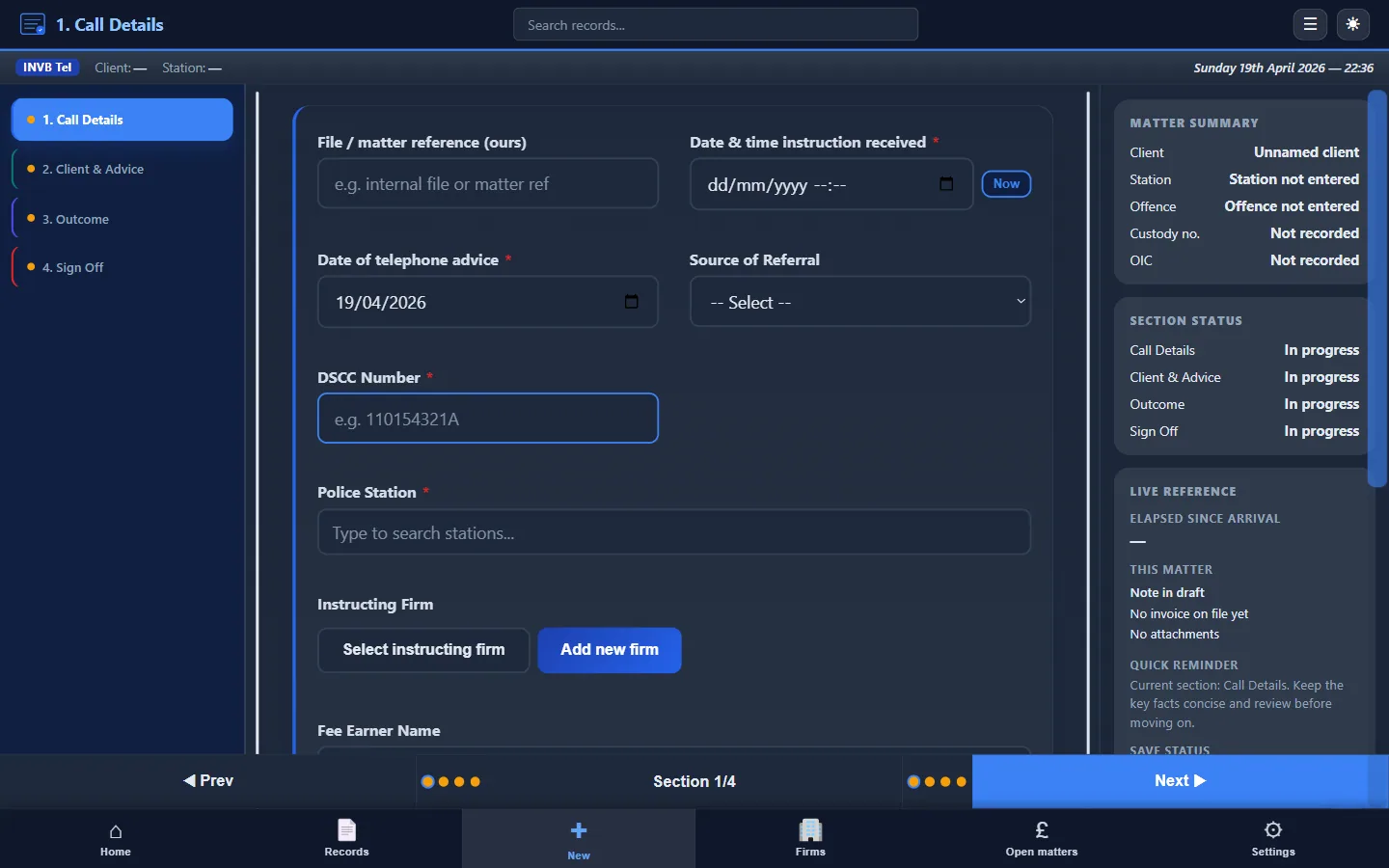
Example 3 — Telephone advice
Date: 25 March 2026, 19:40
DSCC Ref: 2345678
Client: R. Davies
Station: Central Police Station
Offence: Possession of cannabis — Misuse of Drugs Act 1971, s.5(1)
Call from: DSCC
Spoke to custody officer: confirmed client arrested for small quantity of cannabis for personal use. No previous convictions disclosed. Client described as calm and cooperative.
Spoke to client by telephone: explained allegation and likely disposal. Advised that for a first offence of simple possession of a small quantity, a caution or community resolution is the most common outcome. Discussed options: recommended accepting caution if offered, or requesting further advice if the allegation changes or additional offences are raised.
Outcome: client accepted simple caution. Matter concluded by telephone.
Time: telephone attendance 15 min total.
Short and proportionate — but still captures the allegation, the advice, the client's decision, and the outcome. A telephone advice note that says only “called station, advised client, caution given” is inadequate.
Generate this structure on every attendance
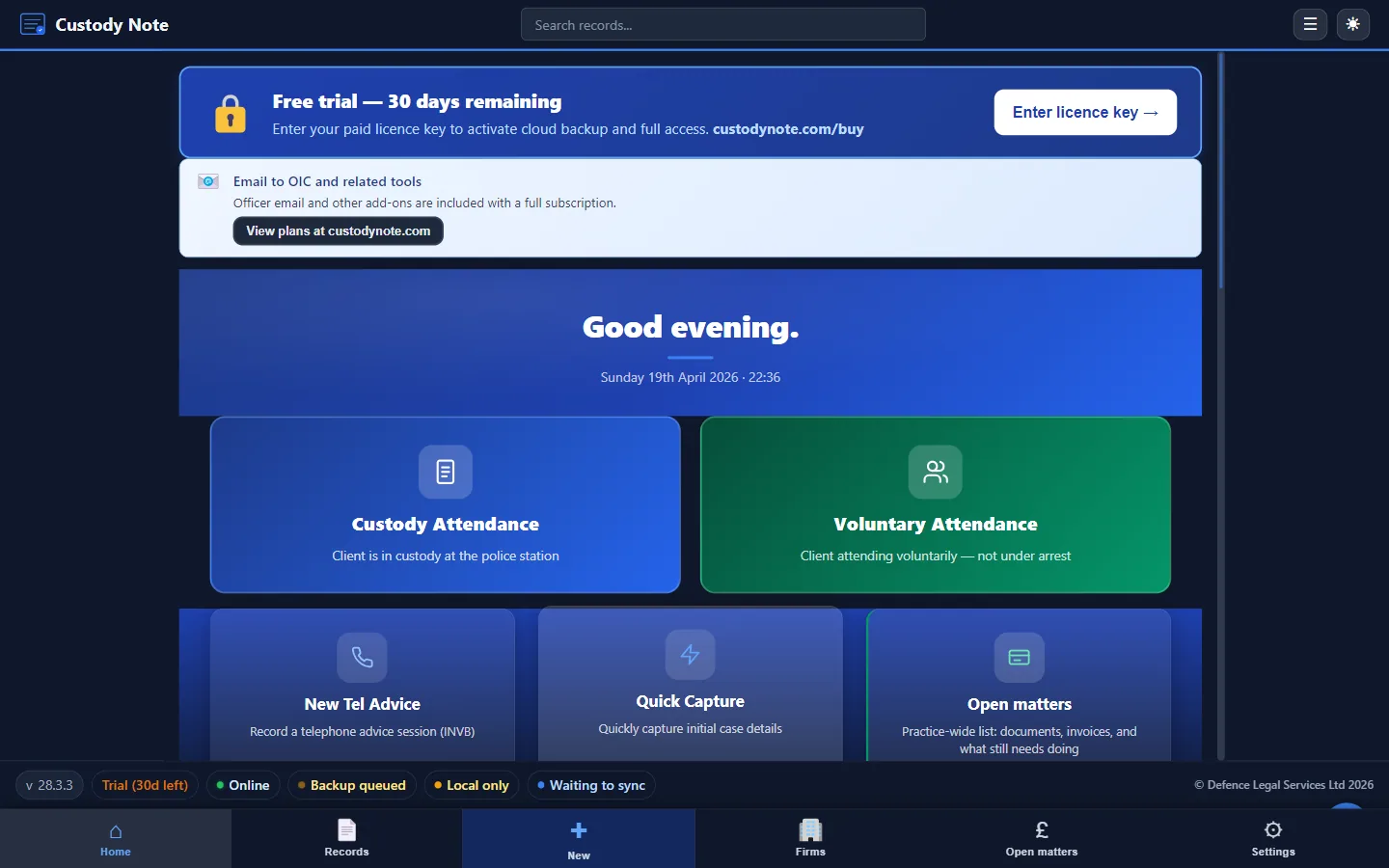
These examples follow the section structure used by Custody Note. The app walks you through each field in real time, works offline at the station, and exports the finished note as a PDF.
Produce this level of structure on every attendance — without slowing down.
Custody Note guides you through each section, works offline, and exports a PDF in one click. Free during beta, no credit card.
Download free