How to Record Disclosure Notes at the Police Station
Disclosure (what the police tell you about the case before interview) is one of the most important things to record in your attendance note. Here is what to capture and why.
Before every police station interview, the investigating officer is expected to provide the defence solicitor with sufficient disclosure to allow informed legal advice. This obligation, rooted in PACE Code C paragraph 11.1A, is the foundation of effective police station representation. Yet in practice, disclosure is often poorly recorded, or not recorded at all, in attendance notes.
I'll cover what disclosure is, the forms it takes, what to record and when, why the disclosure record is important for the case and for billing, and the mistakes I see most often.
What is pre-interview disclosure?
Pre-interview disclosure is the information the police provide to the defence about the case before the interview takes place. Its purpose is to enable the solicitor to give informed advice to the client about how to respond during the interview. Without adequate disclosure, the solicitor can't properly advise on whether the client should answer questions, give a prepared statement, or exercise the right to silence.
The obligation arises from PACE Code C 11.1A, which states that before an interview the investigating officer must disclose sufficient information to enable the solicitor to understand the nature of the suspected offence and the reasons for the arrest. The extent of disclosure is a matter of judgement for the officer, but it must be enough for the solicitor to give meaningful advice.
For a full treatment of what PACE requires, see Disclosure in Police Interview.
Types of disclosure
Disclosure at the police station takes several forms, and your attendance note should record which type was provided:
- Written summary: some forces provide a typed or handwritten disclosure document setting out the offence, the evidence, and the basis for arrest. This is the most helpful form of disclosure because it creates a fixed record that both parties can refer to.
- Oral disclosure: more commonly, the officer provides disclosure verbally, either in a face-to-face briefing or over the phone. Oral disclosure varies enormously in quality and detail. Some officers provide a thorough account; others give the bare minimum.
- Document disclosure: in some cases, the officer may show or provide copies of witness statements, CCTV stills, photographs, phone records, or other evidential material before the interview. This is less common at the initial interview stage but may occur in more complex cases or on subsequent interviews.
- No disclosure or minimal disclosure: occasionally, the officer declines to provide any meaningful disclosure beyond the offence and arrest circumstances. This is a significant issue that must be recorded, as it directly affects the advice you give and may be relevant to adverse inference arguments later.
What to record about disclosure
Your attendance note should capture the following for every disclosure received:
- Who gave the disclosure: the officer's name, rank, and number. If disclosure is given by a different officer from the interviewing officer, record both.
- When it was given: the time and date. If disclosure was provided in stages (initial briefing followed by further information later), record each stage separately with its own timestamp.
- How it was given: written, oral, or by showing documents. If oral, note that you're recording it from memory or contemporaneous notes.
- What was disclosed: the substance of the information provided. Record the offence, the evidence described, the account of the complainant or witnesses (if given), and any specific questions the officer indicated they intended to ask.
- What wasn't disclosed: if you asked for further information and it was refused, record what you asked for and the officer's response. This is critical for adverse inference arguments.
- Your assessment: was the disclosure adequate for you to advise the client? If not, what was missing? Record your professional assessment at the time, because this contemporaneous record will carry far more weight than a retrospective opinion.
Why disclosure records matter at trial
If the case proceeds to trial and the defendant didn't answer questions in interview, the prosecution may invite the court to draw adverse inferences under section 34 of the Criminal Justice and Public Order Act 1994. The defence may argue that the inference shouldn't be drawn because disclosure was inadequate: the defendant couldn't reasonably have been expected to mention facts when the police had not provided sufficient information for meaningful advice.
Your attendance note is the primary evidence for this argument. If it records that disclosure was limited to “an allegation of assault on 15 March” with no detail of the complainant's account, the evidence relied upon, or the specific conduct alleged, that contemporaneous record supports the submission that disclosure was inadequate. If your note says nothing about disclosure, counsel has nothing to work with.
The same principle applies in cases where additional disclosure is provided mid-interview or before a second interview. Recording each stage of disclosure separately creates a clear chronology that counsel can use at trial.
Why disclosure records matter for billing
Disclosure is substantive legal work. Receiving disclosure, assessing it, requesting further information, and advising the client on the basis of what has been provided all take time that should be reflected in the attendance note and the billing claim. A note that skips over disclosure and jumps straight to “consultation with client” fails to evidence a significant portion of the work done.
For complex cases with multiple disclosure stages, the time spent on disclosure can be substantial. Recording it properly ensures that the time is captured in the billing claim. For more on how attendance notes support legal aid billing, see Police Station Interview Notes.
Common disclosure recording errors
In practice, these are the most frequent mistakes practitioners make when recording disclosure:
- No disclosure entry at all: the note jumps from arrival to consultation with no record of what the police told the solicitor about the case. This is the most common error.
- Recording the offence but not the evidence: the note says “disclosure: GBH s.20” but doesn't record what evidence the officer described, what account the complainant gave, or what CCTV or other material was mentioned.
- No timestamp: the note records what was disclosed but not when. That's important because the timing of disclosure affects the time available for consultation and may be relevant if adequacy is later disputed.
- No assessment of adequacy: the note records what was said but not whether the solicitor considered it sufficient. Recording your assessment at the time is far more persuasive than asserting inadequacy months later from the witness box.
- Failing to record requests for further disclosure: if you asked for more information and the officer declined, this must be in the note. It's often the strongest evidence that disclosure was inadequate.
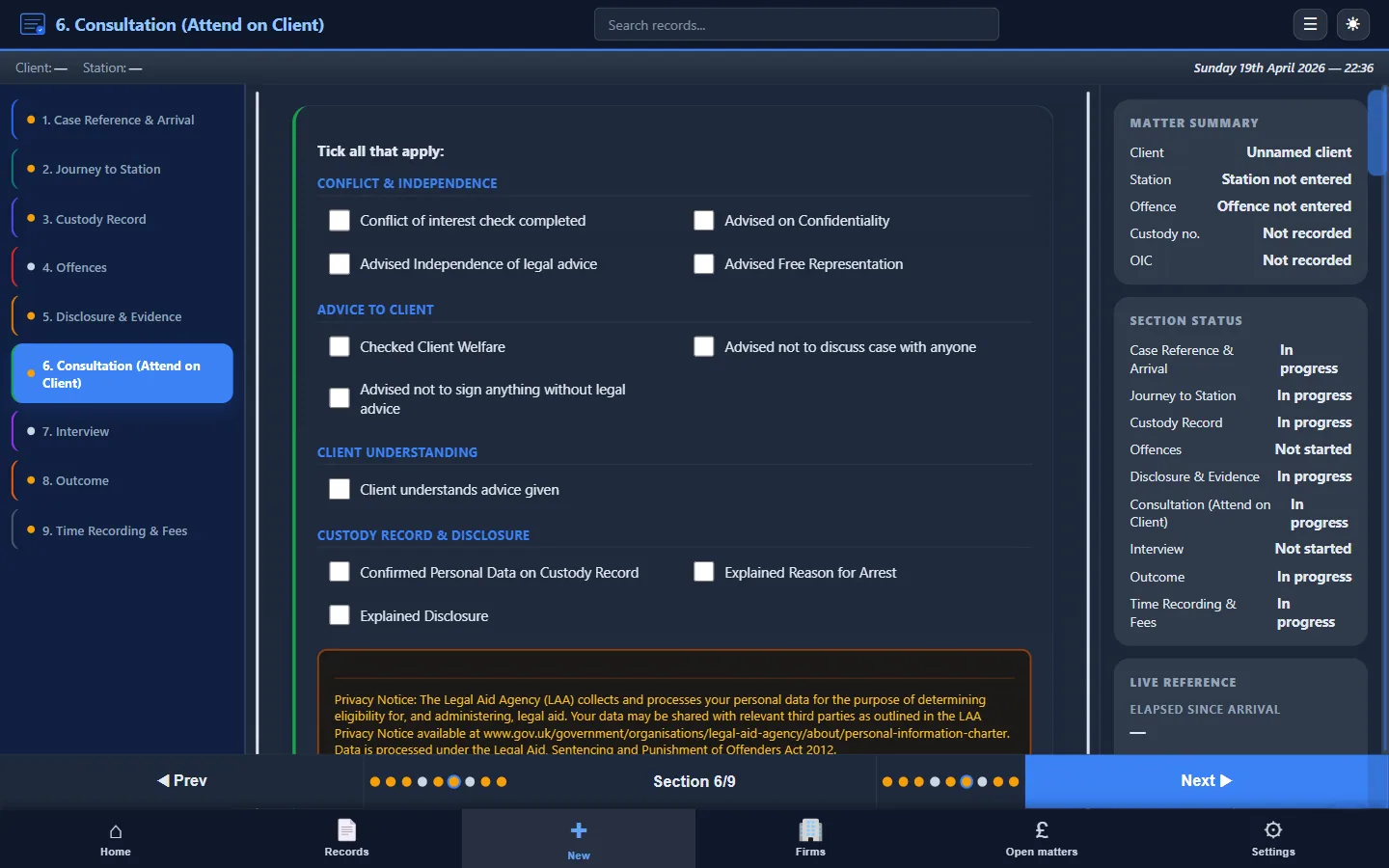
How Custody Note structures disclosure recording
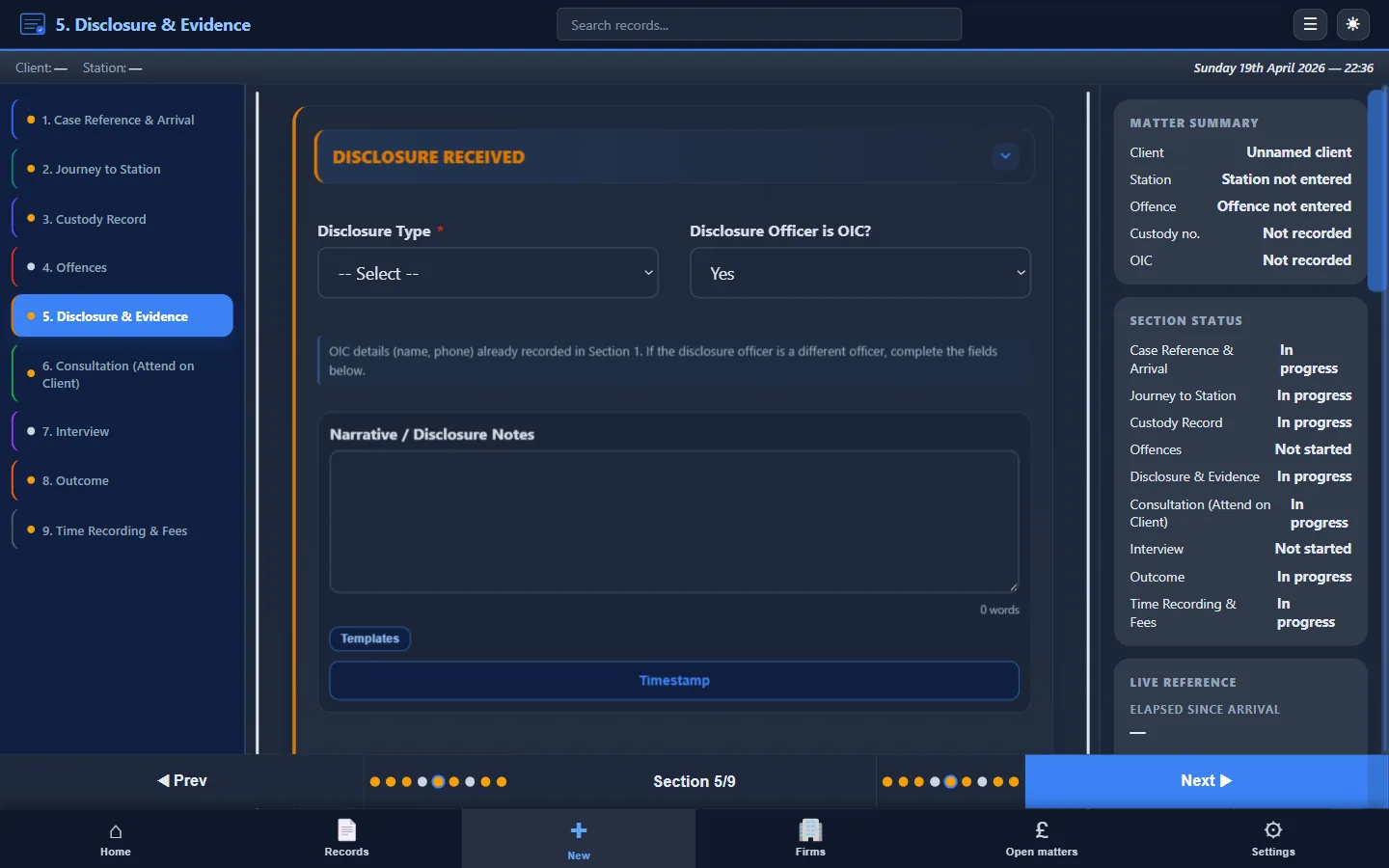
Custody Note includes a dedicated disclosure section within the attendance note structure. This section prompts for the officer providing disclosure, the time it was given, the format (written, oral, or documents), the substance of the information provided, any requests for further disclosure, and the solicitor's assessment of adequacy.
Because the disclosure section sits between the arrival/custody record review stage and the consultation stage, practitioners complete it in the natural chronological order of the attendance. This ensures that disclosure is recorded before the consultation, which means the consultation entry can properly reference what was disclosed and how it informed the advice given.
For the full picture of how police station attendance notes should be structured, see our pillar guide.
Summary
Disclosure is the foundation of your advice at the police station, and your record of it's the foundation of any later argument about adverse inferences, interview strategy, or the adequacy of police conduct. Record who gave the disclosure, when, in what form, what was said, what wasn't said, and your assessment of its adequacy. Do this at the time, not from memory later. A structured attendance note, whether in software or on paper, should treat disclosure as a discrete, time-stamped section that's completed before the consultation entry.
Frequently asked questions
What if the police refuse to provide any disclosure?
Record the refusal, the officer who refused, and the time. Note any reasons given. This is a significant event that directly affects your advice and may be central to an adverse inference argument at trial. Your contemporaneous record of the refusal is the strongest evidence available if the issue is later disputed.
Should I record disclosure verbatim or in summary?
For written disclosure, note that a written document was provided and retain a copy if possible. For oral disclosure, record a detailed summary as close to verbatim as you can manage. The key is to capture the substance (what offence, what evidence, what account) accurately enough that your note can be relied upon months or years later.
Does disclosure recording differ for multiple interviews?
Yes. If the police provide additional disclosure before a second or subsequent interview, record each disclosure stage separately with its own timestamp, content, and adequacy assessment. This creates a clear chronology showing how the evidential picture developed and how your advice responded to it. For guidance on recording interview content, see Download free to explore how Custody Note handles multi-interview attendances.
Never miss a disclosure detail again
Custody Note's dedicated disclosure section prompts for who, when, what, and your assessment: built into the natural flow of the attendance. Free during beta.
Download freeRelated articles from the blog
Custody Records
DSCC References, Custody Records and Attendance NotesCustody Records
Common Mistakes in Custody RecordsApp Features
Custody Note for Windows is on the Microsoft Store (UK)